
What are AI agents?_
A complete guide to understanding, building, and using AI agents
Chapter List
- What is an AI agent?
- How do AI agents work?
- What are the key characteristics of AI Agents?
- What do AI agents do?
- What are the different types of AI agents
- What is a multi-agent system?
- What is an agentic system?
- How are agentic systems different from other AI systems?
- How are AI agents different from workflows?
- How are AI agents different from non-agentic AI bots?
- What are the benefits of using AI Agents?
- What are the challenges of using AI Agents?
- How do you implement AI agents?
- What technical skills do you need to build and use AI agents?
- Where AI agents go next (and where you fit in)
AI agents have progressed dramatically in the past few years, outpacing the usual speed of technological advancement. At work, at home, across daily routines… things are changing for everyone. So, we believe that means everyone should have the opportunity to benefit from AI agents, not just tech experts.
This guide is written for curious minds—whether you’re motivated by the fear of falling behind or simply eager to challenge yourself and learn something new—this one’s for you.
Inside this guide to AI agents, we’ll answer all your key questions in plain language, helping you see what AI agents are, how they work, and how you can start using them to your advantage. Then, maybe we can build some cool things together.
What is an AI agent?
An AI agent is a computer system (software or hardware) that can perceive its environment, reason about what it perceives, and take actions to achieve specific goals.
Many agents are built on large language models (LLMs) or other reasoning engines, so you may also see them referred to as LLM agents. However, LLMs are an enabler, not a requirement.
These agents can take different forms depending on where and how they operate. Some are built into physical machines that interact with the real world, while others exist entirely in digital environments, perceiving and acting through data and software. Understanding these two categories—hardware AI agents and software AI agents—is the first step to seeing how agents show up in everyday life and business.
Hardware AI agents
Hardware AI agents are AI systems that are physically embedded in devices or robots, allowing them to perceive and interact with the real world through sensors, actuators, and other physical components.
They are a lot less common than software agents due to their higher costs, regulatory complexity, safety requirements, and longer development cycles. However, they are still advancing steadily as sensors become cheaper and more capable, AI chips become more powerful and energy-efficient, and manufacturing costs decrease, making sophisticated hardware AI agents increasingly practical for everyday applications.
Software AI agents
Software AI agents are AI systems that operate entirely in digital environments, running on computers, servers, or cloud platforms rather than being embedded in physical machines. They perceive and interact with the world through data inputs such as text, images, APIs, or network signals, and carry out actions like generating content, making decisions, or triggering other software processes.
They are far more common than hardware AI agents because they are easier and faster to develop, have lower deployment and maintenance costs, and avoid most physical safety and regulatory challenges. This makes them ideal for applications like virtual assistants, chatbots, autonomous data-analysis tools, and many more use cases.
As computing power and large language models (LLMs) continue to improve, software AI agents are rapidly becoming more capable, scalable, and integrated into everyday digital workflows.
AI Agent popularity
Software AI agents are by far the most popular type of AI agent today, particularly conversational AI agents and task automation agents. This popularity is likely why you are here, reading this guide. However, current trends show that all AI agents are experiencing explosive growth and adoption across workplaces, homes, and online searches alike.
How do AI agents work?
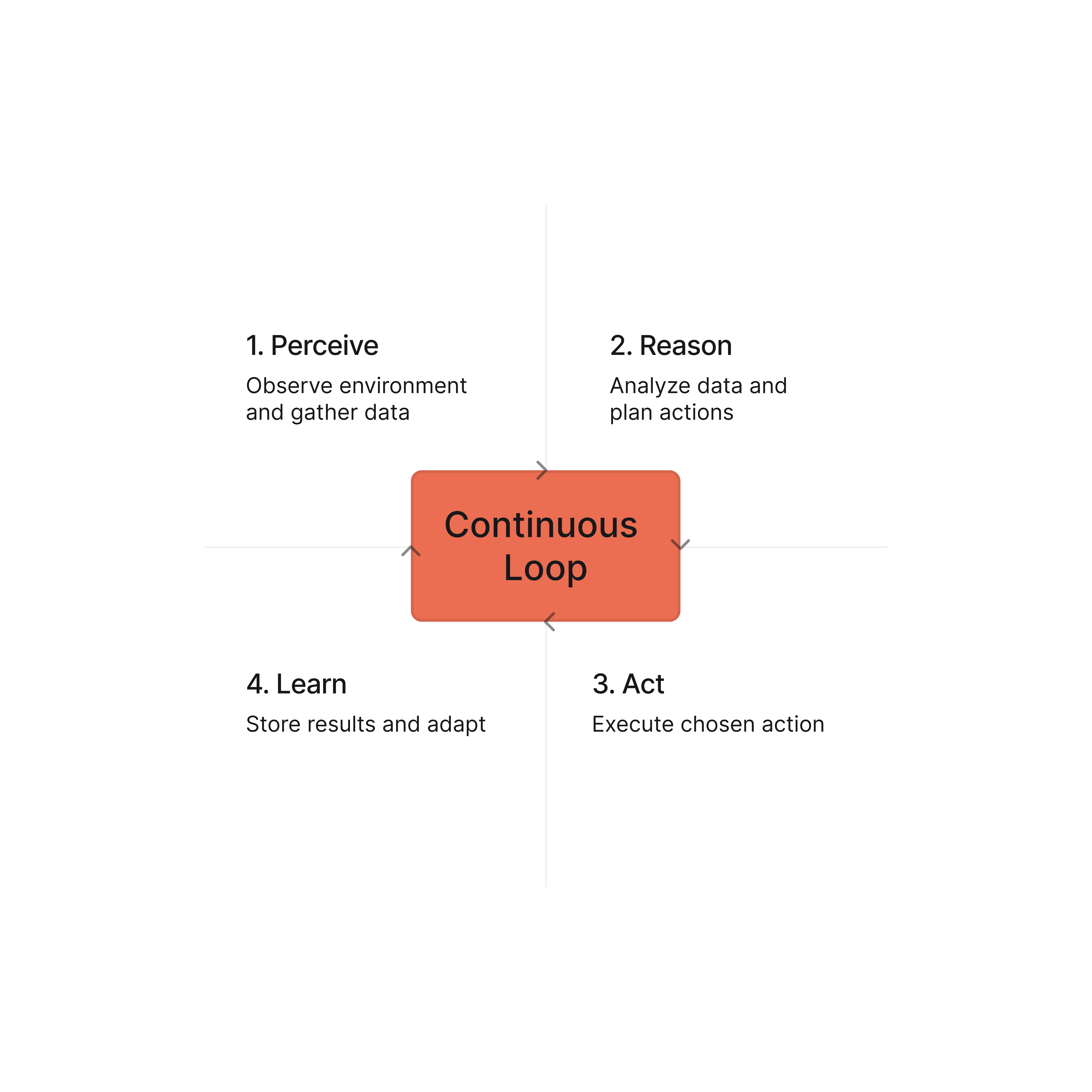
AI agents work by sensing their environment, reasoning about what they perceive, and taking actions to achieve specific goals that they’ve been set.
Many frameworks describe AI agents as running in a self-directed sense–think–act loop:
Perceive → Reason/Plan → Act → (Store/learn) → Repeat
What are the key characteristics of AI Agents?
Whether they exist in software (like digital assistants and automated research tools) or in hardware (like self-driving cars and industrial robots), all AI agents share key traits that enable them to operate effectively and adapt to change.
Goal-oriented behavior
An AI agent requires goals and predefined rules set by humans. Everything the agent perceives, reasons about, and acts on is guided by the objective it was given.
Example: “Find the best route to deliver packages in under 30 minutes.”
Autonomy
An AI agent operates with minimal or no human intervention once given a goal. It decides what actions to take and when to take them, and it can continue working even if conditions change.
Example: “A self-driving car deciding when to brake or change lanes.”
Perception
An AI agent can sense and interpret its environment using data inputs.
Example: A chatbot analyzing user messages to understand intent.
Reasoning & decision-making
An AI agent can sense and interpret its environment using data inputs, perceiving and responding to changes in real-time. This means an AI agent can adapt its behavior based on new information or circumstances. AI agents use AI models, rules, or logic to plan their next steps.
Example: A trading bot weighing risk vs. profit before making a trade.
Action & actuation
An AI agent acts back on the world—digital or physical.
Example: An AI assistant booking a meeting directly on your calendar.
Adaptivity & learning
An AI agent can improve over time or adapt in real time, learning from feedback, new data, or past successes and failures. And AI Agents adjust strategies when conditions change.
Example: A recommendation engine that refines suggestions based on user clicks.
Continuous, proactive operation
An AI agent can run indefinitely and can take initiative to pursue its goals, anticipating future needs and acting preemptively rather than waiting for instructions.
Example: A cybersecurity agent that constantly scans for vulnerabilities and deploys protective measures before a breach occurs.
What do AI agents do?
Now that you know what AI agents are and how they work, let’s explore what they can actually do. Unlike previous types of AI tools, their capabilities go far beyond simple chat or rule-based tasks.
Leading organizations are increasingly integrating AI agents and systems into their daily operations. These AI-powered “digital workers” excel at streamlining customer support, optimizing supply chains, enhancing marketing and sales efforts, and analyzing data across industries such as finance and healthcare.
Individuals are also beginning to incorporate AI agents into their everyday lives, using them as personal digital assistants that go well beyond simple chat. These autonomous helpers can manage calendars and email, plan trips, automate household tasks, track spending and investments, organize health and fitness data, or even help with hobbies like writing, cooking, and learning new skills. By handling routine decisions and complex planning, AI agents are becoming powerful tools for saving time, staying organized, and enhancing personal productivity and creativity.
What are some real-life examples of AI agents?
Business & productivity AI agent examples
- Autonomous research assistants
- Can read documents, perform web searches, summarize findings, and draft reports without step-by-step prompting.
- Customer service agents
- Understand user questions, troubleshoot issues, and even trigger actions like refunds or reorders.
- Sales and marketing agents
- Qualify leads, schedule meetings, and personalize outreach across multiple channels.
- Finance & operations bots
- Monitor transactions for fraud, rebalance investment portfolios, or handle dynamic supply-chain scheduling.
Personal & everyday life AI agent examples
- Virtual personal assistants
- Manage calendars, control smart-home devices, plan trips, or automatically reorder groceries.
- Email and task agents
- Sort and prioritize email, draft replies, and schedule meetings autonomously.
- Personal finance agents
- Track spending, flag unusual charges, and suggest ways to save or invest.
Robotics & physical world AI agent examples
- Self-driving cars
- Perceive surroundings via cameras and LiDAR, reason about traffic, and act by steering, braking, or rerouting.
- Warehouse & delivery robots
- Coordinate picking, packing, and routing in dynamic environments.
- Drone fleets
- Plan flight paths, avoid obstacles, and collaborate on deliveries.
Science & society AI agent examples
- Healthcare agents
- Analyze patient data, suggest diagnoses, and propose personalized treatment plans.
- Environmental monitoring
- Continuously analyze sensor data and trigger alerts or interventions.
- Multi-agent simulations
- Agents represent people, vehicles, or particles to model and manage large-scale phenomena.
What are the different types of AI agents
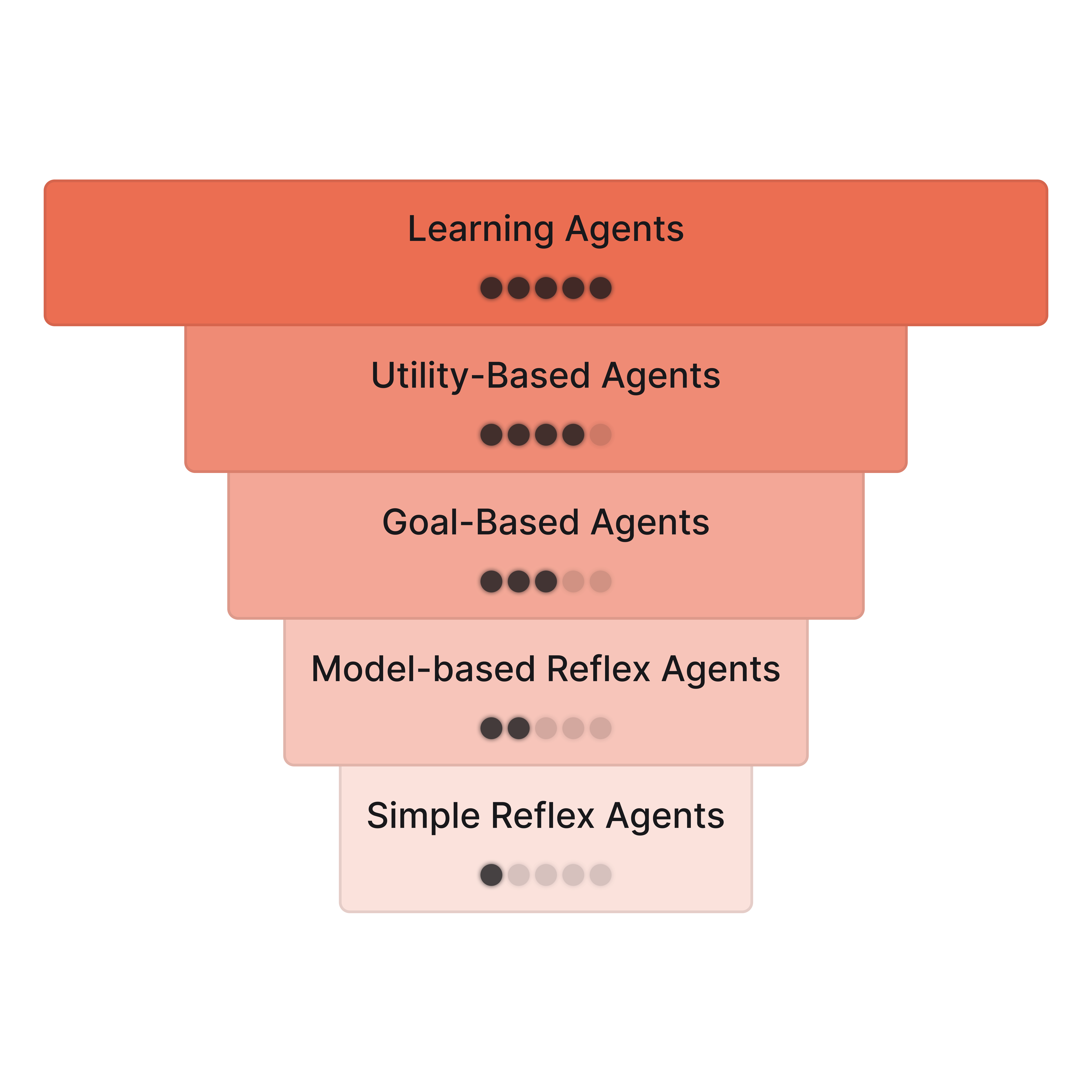
AI agents can be built to have varying levels of capabilities. There are five different types of AI agents, based on how much they can perceive, reason, adapt, and plan.
Simple reflex agents
The simplest type of AI agents, simple reflex agents, don’t hold any memory, nor do they interact with other agents. They act purely on current input using predefined rules like if condition → do action.
Example: A smart thermostat adjusting temperature based on a sensor reading.
Model-based reflex agents
Model-based reflex agents go a step beyond simple reflex agents. They do hold memory—building and updating an internal model of their environment that lets them keep track of aspects that aren’t immediately visible. While they still rely on condition–action rules, the internal model provides context, allowing more informed and adaptable responses than simple reflex agents.
Example: A self-driving car maintains a dynamic map of nearby vehicles.
Goal-based agents
Another step up, goal-based agents have an internal model of the world and also a goal or set of goals. Flexible and capable of choosing among multiple strategies, these agents plan actions by evaluating different possibilities and selecting action sequences that achieve their specific goal.
Example: A navigation system that recommends the fastest route to your destination.
Utility-based agents
The next progression, utility-based agents select the action sequences that achieve their specific goals while also maximizing the expected utility (how desirable a particular state or outcome is).
Example: A stock-trading bot that balances risk and profit to select trades with the highest expected return.
Learning agents
Last up, learning agents have the same capabilities as the other AI agent types, but they are unique in their ability to learn from experience and feedback continuously. Learning agents improve their performance over time, which enhances the agent’s ability to operate in unfamiliar environments.
Example: A personalized recommendation service for e-commerce sites that tracks user activity and preferences to improve the recommendations.
Now that we’ve explored the five main types of individual AI agents and how their capabilities range from simple rule-following to continuous learning, it’s time to look at what happens when multiple agents work together.
What is a multi-agent system?
In many real-world applications, complex goals are too large for a single AI agent to handle efficiently. This is where multi-agent systems (MAS) come in.
A multi-agent system is a computational framework made up of multiple autonomous AI agents that interact with one another and their shared environment. These agents may collaborate, coordinate, or even compete to achieve individual objectives, shared goals, or both.
Pros of multi-agent systems
- Scalable: tasks can be distributed across many agents
- Robust: tolerant to individual agent failure
- Specialized: agents can focus on different roles
- Flexible: adapt to changing conditions
- Collaborative: agents can negotiate and discover novel solutions
Cons of multi-agent systems
- Complex coordination and communication
- Higher development and maintenance costs
- Risk of unpredictable emergent behaviors
- Resource-intensive (compute and networking)
- Greater security and governance challenges
What is an agentic system?
As AI matures, many tasks require more than just multiple agents working together—they need a cohesive, end-to-end framework that can set goals, plan, act, and adapt over time. This is where agentic systems come in.
An agentic system is a full AI architecture built around one or more autonomous agents that perceive, reason, act, and learn continuously to achieve complex objectives. Unlike a multi-agent system, which focuses mainly on coordination among agents, an agentic system provides the overarching structure—including memory, tool usage, and governance—that enables those agents (whether one or many) to operate as a single intelligent whole.
Pros of agentic systems
- End-to-end autonomy: can pursue high-level goals with minimal human input
- Continuous operation: monitors conditions and acts proactively over long timeframes
- Adaptive and goal-driven: adjusts strategies as data and circumstances change
- Integrates tools and memory: calls APIs, executes code, and remembers context across sessions
- Scalable design: supports one powerful agent or many collaborating agents
Cons of agentic systems
- Greater complexity: more challenging to design, test, and govern than single agents or simple workflows
- Higher compute and infrastructure needs: continuous reasoning and memory demand significant resources
- Unpredictable outcomes: autonomy and adaptability can introduce unexpected behaviors
- Stronger governance required: needs robust safety, audit, and access controls
How are agentic systems different from other AI systems?
Agentic systems are a step beyond traditional AI systems, adding autonomy, goal-directed coordination, and continuous operation that most conventional AI setups don’t have.
Agentic systems are ideal for open-ended, evolving, and multi-step objectives that benefit from autonomy and adaptability. Traditional AI systems excel at specific, well-defined problems where speed, predictability, and tight control are most important.
How are AI agents different from workflows?
AI agents and workflows both help automate tasks, but they differ fundamentally in flexibility, reasoning, and autonomy. Workflows are predefined sequences of steps that are triggered by specific conditions. Unlike AI agents, workflows always follow the same predefined path.
How are AI agents different from non-agentic AI bots?
AI agents and non-agentic AI bots both leverage artificial intelligence to assist with tasks, but they differ fundamentally in autonomy, reasoning, and adaptability. Non-agentic AI bots are primarily reactive systems that respond to user prompts or fixed triggers and operate within predefined boundaries. Unlike AI agents, they cannot independently plan multi-step goals, learn from ongoing context, or initiate actions beyond the immediate interaction.
What are the benefits of using AI Agents?
Increased efficiency and productivity
AI agents can take over repetitive, time-consuming tasks—from scheduling meetings and answering routine customer questions to processing financial transactions—allowing humans to focus on higher-value work.
Agents can work on different things at the same time without getting in each other's way. Their activities don’t create bottlenecks or conflicts, even as they share data or resources.
Improved decision-making
AI agents can significantly improve decision-making by combining continuous data analysis, autonomous reasoning, and proactive action. They can adapt their plans as situations change, ensuring they continue to select the best sequence of actions even in dynamic environments.
Fewer errors
AI agents execute tasks with precision and accuracy and without fatigue or bias. They reduce errors and slip-ups that would be inevitable if the same tasks were completed by humans.
24/7 availability
AI agents can operate around the clock without breaks, delivering uninterrupted service and immediate responses. Whether it’s handling customer support requests at midnight or monitoring critical systems for anomalies, they ensure important tasks continue without downtime, no matter the time zone or workload.
Reduced costs long-term
By automating routine tasks and streamlining operations, AI agents can significantly lower operational costs. They scale to handle increasing workloads without hiring additional staff and optimize resource use, which results in long-term savings and faster return on investment.
What are the challenges of using AI Agents?
Complexity and maintenance
Building and managing AI agents is more complex than traditional software. They often require multiple components like reasoning engines, memory, tool integrations, and safety layers to work together seamlessly. Keeping these systems reliable, secure, and up to date can demand significant effort and specialized expertise.
Agno is designed to absorb that complexity. Its modular architecture lets teams swap LLMs, databases, or vector stores without rewriting code, while bundling memory, knowledge, tools, guardrails, and human-in-the-loop into a single framework. Clean abstractions and straightforward APIs mean agents can be stood up in just a few lines of code, and an integrated control plane gives engineers real-time monitoring, tracing, and management from one place, turning what would normally require deep infrastructure work into something a team can ship and maintain with confidence.
Higher resource demands
Sophisticated AI agents can be computationally expensive, often running continuously and processing vast amounts of data. This makes them resource-intensive, potentially putting them out of reach for smaller projects or organizations with limited budgets.
Agno is built to be lightweight from the ground up. The framework uses up to 50x less memory than alternatives like LangChain, which makes a real difference when scaling or running locally. Its async-first design and ready-to-use FastAPI runtime let teams scale from a single agent to thousands of concurrent sessions without overprovisioning. And because Agno is model-agnostic, supporting everything from OpenAI and Anthropic to local open-source models, teams can choose the most cost-appropriate option for each task rather than being locked into expensive providers.
Unpredictable behavior
Because AI agents act autonomously and may collaborate with other agents, they can behave in unexpected ways. Adapting to new environments or encountering novel inputs can lead to actions or outcomes that are difficult to explain, predict, or control.
Agno builds in multiple layers of oversight to keep agents on track. Validation guardrails assess consistency, correctness, and compliance before outputs are shared or acted upon, while human-in-the-loop support lets teams require confirmations, approvals, or overrides for high-stakes decisions. Engineers can inspect reasoning traces and understand every tool call, making it straightforward to debug failures and understand why an agent behaved the way it did. Built-in evals for accuracy, reliability, and performance close the loop, giving teams the visibility they need to catch problems early and improve agent behavior over time.
Data privacy and security risks
AI agents often access sensitive data—emails, financial records, customer information, proprietary documents, etc. Without strong governance, they may expose confidential data, create new attack surfaces, or violate privacy regulations.
Agno treats security as a core architectural concern, not an afterthought. The entire AgentOS runs in your cloud, meaning usage logs, metrics, traces, memory, and user data never leave your environment. JWT authentication, role-based access control, and request-level isolation are built into the framework from the start. On the input side, built-in guardrails automatically detect PII like Social Security numbers, credit card numbers, and email addresses, while prompt injection guardrails catch common manipulation attempts before they reach the model. Teams can layer multiple guardrails together and create custom ones for domain-specific threats, establishing defense-in-depth security across the entire agent lifecycle.
Ethical concerns
AI agents lack a moral compass and make decisions purely from data and logic. In high-stakes contexts—such as healthcare diagnosis and treatment, judicial decision-making, or law enforcement—this can lead to outcomes that may conflict with human values or ethical standards.
Agno gives teams the tools to keep human judgment in the loop where it matters most. Post-execution guardrails automatically review agent outputs for bias, policy violations, or off-policy content before anything is published or acted upon. Human-in-the-loop workflows ensure that consequential decisions get reviewed and approved by a person rather than executed blindly. Type-safe input and output schemas enforce structured, predictable behavior, reducing the chance of agents improvising in sensitive contexts. Together, these controls let organizations set clear ethical boundaries and ensure agents operate within them.
Limited emotional intelligence and social nuance
Tasks that require deep empathy, emotional understanding, or complex social judgment remain out of reach. AI agents struggle with unspoken cues and nuanced human emotions, making them ill-suited for fields like therapy, social work, counseling, or conflict resolution.
This is a fundamental limitation of AI models themselves, and no framework can fully solve it. What Agno does offer is flexibility. Because it's model-agnostic, teams can swap in whichever model handles nuanced interactions best for their use case, whether that's a frontier model from Anthropic or OpenAI or a fine-tuned specialist. More importantly, human-in-the-loop capabilities mean agents can be configured to escalate to a real person when a situation calls for empathy or social judgment rather than attempting to handle it alone.
Challenges in unpredictable physical environments
In highly dynamic, real-world settings that demand complex motor skills and split-second adaptation, such as surgery, certain construction tasks, or disaster response, AI agents may not yet match the flexibility and situational awareness of skilled humans.
How do you implement AI agents?
1. Define Purpose and Goals
- Identify the problem or opportunity: Determine what specific pain points or business needs the AI agent will address.
- Define objectives: Set clear, measurable goals for the agent to achieve.
2. Choose Technology and Tools
- Select frameworks: Choose a suitable development framework (like Agno).
- Identify necessary tools: Determine if the agent needs tools for data retrieval (e.g., RAG systems) or interacting with other services via APIs.
3. Gather and Prepare Data
- Collect relevant data: Acquire the necessary data to train or inform the AI agent about its task domain.
- Assess data quality: Evaluate and ensure the accessibility and quality of the data.
4. Design the Agent
- Map the environment: Understand the external environment the agent will perceive and interact with.
- Design decision-making logic: Plan how the agent will interpret observations, make decisions, and take rational actions to achieve its goals.
- Define the workflow: Outline the steps or nodes within the agent's processing flow.
5. Develop and Test
- Set up the environment: Configure the development environment and install necessary libraries.
- Build the agent: Write the code or use the tools to implement the agent's nodes and edges, connecting them in a logical sequence.
- Test thoroughly: Conduct comprehensive testing to ensure the agent performs as expected, iterating on the design as needed.
6. Deploy and Monitor
- Deploy the agent: Make the agent available in a production environment.
- Monitor performance: Continuously track key performance indicators (KPIs) to evaluate its effectiveness against the initial goals.
- Optimize and iterate: Refine the agent's strategies and capabilities based on the performance data and feedback.
What technical skills do you need to build and use AI agents?
The surge in AI agent popularity has also led to a surge in user-friendly AI agent solutions. There are now multiple options for no-code platforms, user-friendly frameworks, and pre-built solutions. As a result, you do not need to be highly technical to build or use AI agents.
However, if you are really interested in getting the most out of AI agents, there are a few key skills worth knowing. And not all of them are technical.
The skills you need to build AI agents in 2025
Building and using AI agents involved a mix of technical and strategic skills.
Technical skills you need to build and use AI agents
Building AI agents doesn’t require you to be a full-stack engineer, but having a solid grasp of certain technical skills will make you far more effective. The more technical you’re capable of getting, the more you (and your agents) will be able to accomplish.
Core programming skills
As mentioned earlier, no-code AI agent platforms are available. These are great for straightforward use cases. However, coding skills still unlock significant advantages. If you want to move beyond the limitations of no-code platforms, core programming skills remain essential. We recommend Python. It’s the dominant language for AI development and essential for most frameworks and libraries.
Prompt engineering & LLM orchestration
Because many modern agents rely on large language models (LLMs) like GPT-4, prompt engineering is critical. You’ll need to craft precise, structured prompts, design multi-turn conversations, and manage context across sessions. For multi-agent systems, skills like chaining prompts, coordinating roles, and building reasoning loops can dramatically improve performance.
APIs, tools, and integrations
Agents are most useful when they can take action in the outside world. That often means calling APIs, triggering webhooks, working with databases, or interacting with business apps like Slack, Salesforce, or Google Workspace. Understanding REST APIs, basic JSON handling, and data pipelines will help your agents connect seamlessly with real systems.
Basic data & AI concepts
Familiarity with data structures, version control (e.g., Git), and machine learning basics, such as training versus inference and model fine-tuning, will help you design agents that are both efficient and robust. Even if you don’t train models yourself, knowing how they work will help you troubleshoot and improve your agents.
Strategic skills you need to build and use AI agents
Equally important are the strategic and design skills that ensure your AI agents solve the right problems and stay reliable in production.
Workflow and system design
Building an AI agent isn’t just about writing code. It’s about mapping goals, tasks, and decision points, and deciding when human oversight is required. Clear system design prevents runaway complexity and makes agents easier to scale.
Problem framing and goal definition
A well-scoped goal is the foundation of a successful agent. Learn how to translate business or personal objectives into measurable, actionable outcomes that an agent can pursue autonomously.
Governance and risk management
Autonomous agents can make unexpected decisions. Skills in ethics, compliance, and risk assessment, including data privacy and security, are critical for safe deployment, especially in regulated industries like finance or healthcare.
Iterative testing and monitoring
Agents improve over time, but only if you monitor their performance. Designing feedback loops, tracking metrics, and performing regular audits ensures your agents remain accurate, secure, and aligned with their goals.
Where AI agents go next (and where you fit in)
AI agents are no longer a futuristic concept or a niche tool for research labs. They are already reshaping how work gets done, how decisions are made, and how people interact with technology in their everyday lives. From simple rule-based systems to learning agents, multi-agent systems, and fully agentic architectures, we are witnessing a shift from static software to systems that can reason, act, and adapt over time.
Throughout this guide, we’ve covered what AI agents are, how they work, the different types that exist, and the real-world problems they are already solving. We’ve also been clear about the trade-offs. AI agents offer massive gains in efficiency, scalability, and decision-making, but they introduce new challenges around complexity, governance, and predictability. Using them well requires thoughtful design, clear goals, and ongoing oversight.
The most important takeaway is this: you don’t need to be an AI expert to get started. As agent frameworks, no-code tools, and pre-built systems continue to mature, the barrier to entry is dropping fast. What matters most is understanding when an AI agent is the right tool, what goals it should pursue, and how it should be guided and evaluated.
If you’re looking for a practical place to start, Agno is built specifically for this moment. It is the only tool on the market that offers a truly end-to-end agentic solution, allowing you to build, run, and manage agentic systems in one place. Instead of stitching together models, tools, memory, orchestration, and governance on your own, Agno provides a unified stack designed for real-world agentic applications from day one.
Whether you’re an individual automating parts of your daily life, a team experimenting with digital workers, or an organization deploying production-grade agentic systems, starting with an end-to-end platform dramatically reduces complexity and time to value. It lets you focus on defining problems and designing intelligent behavior, not on wiring infrastructure together.
AI agents are not here to replace human judgment, creativity, or responsibility. They are here to extend what humans can do. And the people who understand how to design, deploy, and collaborate with them will help define the next chapter of software.
If this guide helped you see that future more clearly, then we’ve done our job. Now it’s your turn to build something useful, practical, or even a little ambitious. And when you’re ready to get started, you know where to begin.