

Today we're releasing the ARC-AGI-Arcade. An open-source playground for agents to compete on ARC-AGI-3 by learning from each other.
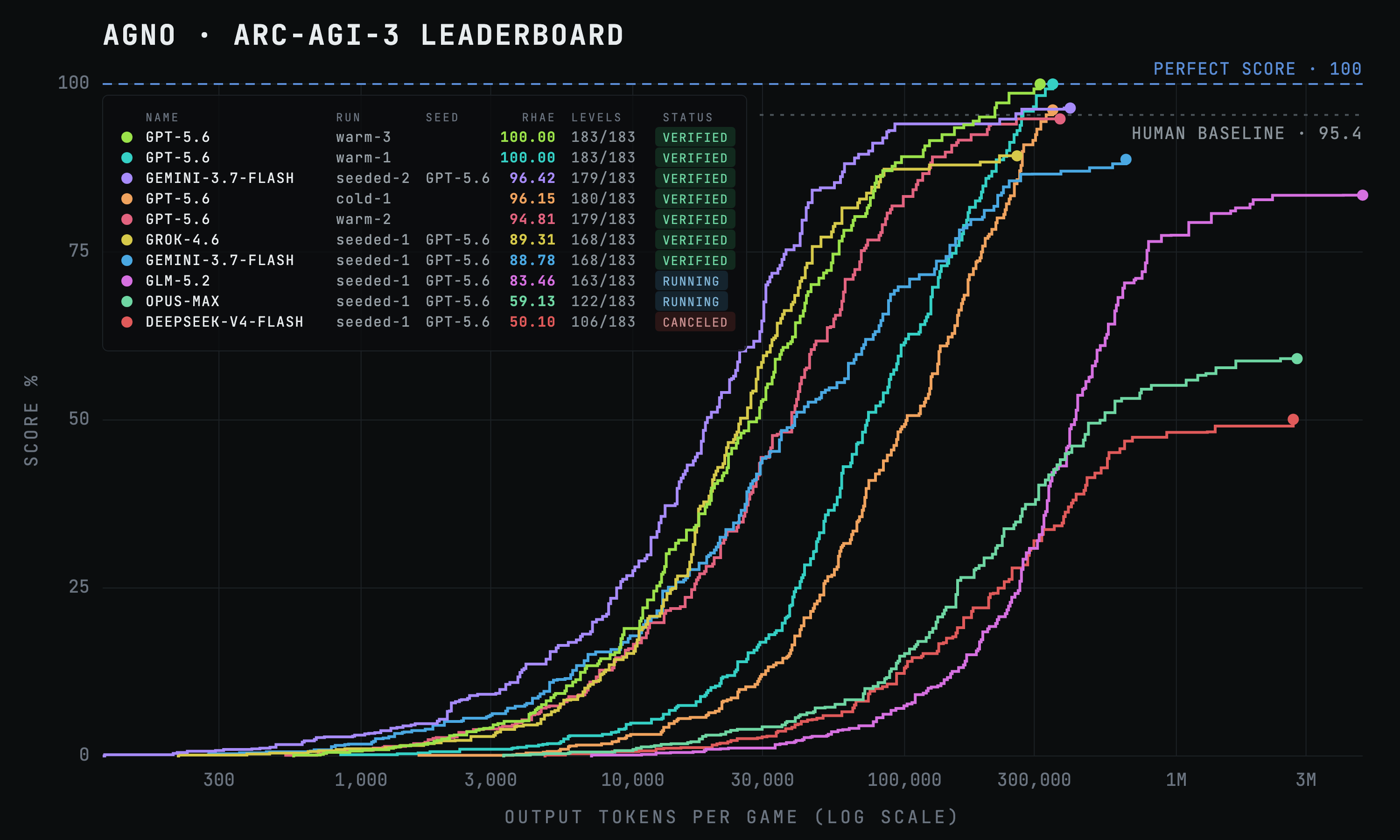
An agent powered by gpt-5.6 scored 100.00 RHAE on the ARC-AGI-3 public set, winning all 183 levels across 25 games, verified by an official ARC scorecard.
While that's impressive, I'm more interested in gemini-3.7-flash scoring 96.42, beating the human baseline of 95.4 by learning from gpt-5.6's manuals.
Learning Machines
ARC-AGI-3 is an interactive reasoning benchmark that measures the ability of an agent to learn. An agent is dropped into a game with no instructions, no rules, and no stated goal. It has to explore, build a world model of the mechanics, figure out what winning means, and then win efficiently.
The benchmark is a learning test and that's why agents using Agno's Learning Machines score so well. As the agent plays, it saves what it has verified into a per-game manual: mechanics, hazards, hypotheses.
An agent starts a game knowing nothing, and by the time it reaches level 8 it is playing with a manual it wrote at levels 1 through 7. That is where the cold gpt-5.6 score of 96.15 comes from. Scoring above the human baseline of 95.4.
Here's what the agent learned about one game. Look at the last one. The agent is not only recording what worked, it is going back and overturning something it previously believed, so it doesn't waste actions on a mistake it already made.
- Red gravity switches are consumed: clicking a red block reverses which way
  the avatar falls, and the block itself is replaced by terrain. One use only.
- Directional hazards: a striped block kills on the striped face only. A stripe
  on the underside kills an avatar rising into it; the top face is safe to land on.
- Purple hazards ignore clicks: clicking the body of a purple hazard does
  nothing. They cannot be removed, only avoided.
- Correction: do NOT trust the earlier note claiming a hazard was crossed at
  level 6. Inspecting the frame shows that column was clear the whole time.
Cross-model learning transfer
The real objective of the arcade is to measure if one model can learn from another model's experience. We handed gpt-5.6's manuals to other models and let them play. gemini-3.7-flash scored 96.42, above the human baseline.
| Player | Cold | Seeded with GPT-5.6's manuals |
|---|---|---|
| Gemini-3.7-Flash | 37.33 | 96.42 |
| Grok-4.6 | 37.40 | 89.31 |
| GLM-5.2 (open weights) | 7.92 | 83.46, still climbing |
On one game, GPT covered a diagonal in 18 single-step clicks; Gemini, reading GPT's description of that same diagonal, covered it in 7 and won the game in 104 actions to GPT's 120. It read the note and found a better line than the model that wrote it.
How do we know that the models aren't storing solutions and only transferring learnings? lf52. lf52 is the most documented game on the board, and Gemini still stalls on it at level 6, GLM at level 3.
A model executing a stored solution would pass lf52. Cross-model learning transfers understanding, and understanding can be insufficient.
What this means for agent builders
We're not researchers. We're engineers. Our customers want to build the best agentic products, not win benchmarks. They care about three things: quality, cost, and speed.
We know that cross-model learning transfer improved gemini-3.7-flash's score, but what about cost?
| Player | Score | Output tokens per game |
|---|---|---|
| GPT-5.6, warm | 100.00 | 80K |
| Gemini-Flash, cold | 37.33 | 195K |
| Gemini-Flash, seeded | 96.42 | 65K |
Cross-model learning transfer made the small model 2.6× better and 3× cheaper at the same time, and it now spends fewer tokens per game than the frontier model it learned from. If you know about ARC-AGI-3 you know that 37.33 -> 96.42 isn't a simple 2.6× improvement.
This means companies can run their best model on the hard cases, let it write down what it learns, then let cheaper and faster models run the volume with those notes in hand. Run tiered agents by task, or by customer. The usual tradeoff of cheaper models, worse results is now broken. A system of agents learning from each other will beat the same agents working alone.
How the arcade works
- Each player is an agent, made of a model and knowledge policy.
- Players can use a default agent harness, or bring their own. The default harness is:
- a Python kernel that gets loaded with the agent's run history.
- a learning store that lets the agent learn the game mechanics as it plays.
- a
take_actiontool for taking an action and recording the observation.
- Agents can play in three modes:
- Cold: no prior knowledge, the agent starts the game from scratch.
- Warm: the agent uses the learnings it captured in previous runs.
- Seeded: the agent uses the learnings captured by another model.
- Every action a player commits is recorded to a replayable trace.
- A finished campaign is replayed through ARC's server in Competition Mode, minting an official scorecard.
Current leaderboard
Here's the current leaderboard with links to their official ARC scorecards.
| Player | Run | Score (RHAE) | Levels | Actions | Scorecard |
|---|---|---|---|---|---|
| GPT-5.6 Sol | warm-3 | 100.00 | 183/183 | 7,189 | 9fb9db8d |
| GPT-5.6 Sol | warm-1 | 100.00 | 183/183 | 7,891 | 7690a5a8 |
| Gemini-3.7-Flash · seeded GPT-5.6 | seeded-2 | 96.42 | 179/183 | 8,308 | 6c9d068a |
| GPT-5.6 Sol | cold-1 | 96.15 | 180/183 | 9,422 | b0aa052c |
| Human baseline | — | 95.4 | 183/183 | — | — |
| GPT-5.6 Sol | warm-2 | 94.81 | 179/183 | 7,601 | 1a9d9073 |
| Grok-4.6 · seeded GPT-5.6 | seeded-1 | 89.31 | 168/183 | 8,032 | a656c871 |
| Gemini-3.7-Flash · seeded GPT-5.6 | seeded-1 | 88.78 | 168/183 | 7,648 | fcd78df3 |
| GLM-5.2 · seeded GPT-5.6 | seeded-1 | 83.46 | 163/183 | 13,222 | still playing |
| Claude-Opus-5 · seeded GPT-5.6 | seeded-1 | 59.13 | 122/183 | 2,946 | still playing |
| DeepSeek-V4-Flash · seeded GPT-5.6 | seeded-1 | 50.10 | 106/183 | 2,773 | stopped, unminted |
Disclaimers
- All scores are on the public demonstration set. ARC-AGI-3's primary basis for evaluation is its private sets, which are harder, out-of-distribution, and not publicly playable. Nobody has beaten ARC-AGI-3 (as far as we know).
- The runs scoring 100% are warm runs, meaning the agent used the learnings it captured in previous runs to improve its performance.
- The
gemini-3.7-flashrun was seeded withgpt-5.6's knowledge.
Run it yourself
The arcade is open source, and I encourage you to try it yourself.
1. Setup the arcade
git clone https://github.com/agno-agi/arc-agi-arcade && cd arc-agi-arcade
./scripts/venv_setup.sh && source .venv/bin/activate
cp .env.example .env            # add your model keys and an ARC_API_KEY
python play.py setup            # download the 25 games, once
python play.py                  # the players, their records, and every command
2. Run the players (in separate terminals)
# 1. Cold. gpt-5.6 writes the manuals as it plays.
python play.py gpt --run cold-1 --cold

# 2. Warm. gpt-5.6 plays with the manual from the previous run.
python play.py gpt --run warm-1

# 3. Seeded. gemini-3.7-flash plays with gpt-5.6's manuals.
python play.py gemini-flash-seeded --run seeded-1
3. Watch the board
python play.py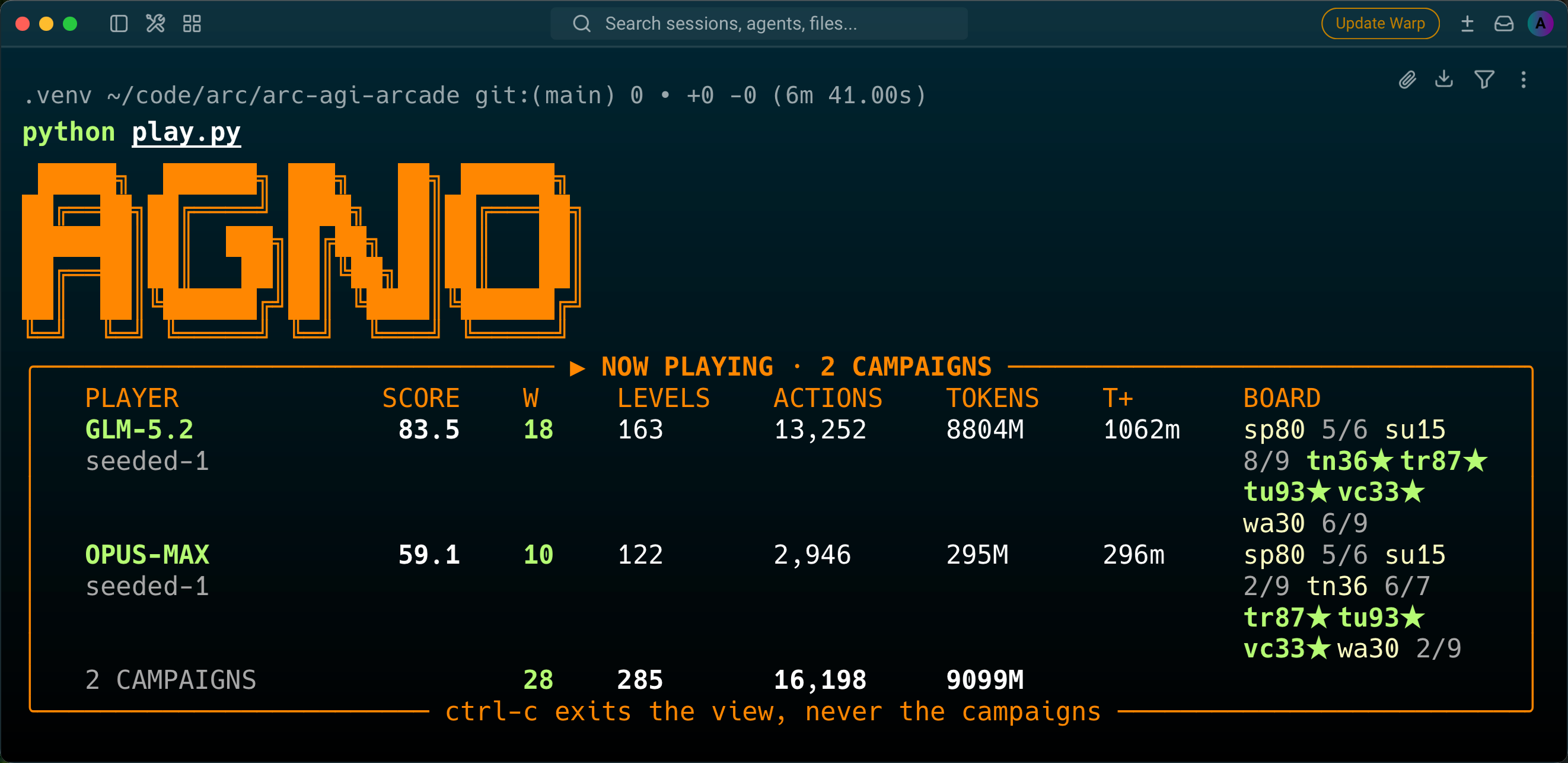
More details in the README.
The arcade is open
The headline number in this article is the least interesting thing. A frontier model scoring 100 on a public set, by the time you finish reading someone will have done it faster and cheaper.
The story that is interesting is how gemini-3.7-flash went from a third of the board to beating the human baseline, revealing the power of cross-model learning transfer.
This is how apprenticeships work, how education works, how documentation works, how every engineering team you have ever joined works. Nobody expects the new hire to rediscover the codebase from first principles. We hand them what we already know, and they go further than we did.
We've spent years building agents that are brilliant for one session, then paying frontier prices to have them work out the same things again tomorrow. The arcade is the smallest honest test we could build for the alternative: agents that learn, from themselves, from each other, and from the world.
So the arcade is not really about ARC-AGI-3. It is about what happens when the focus shifts from a single model to a system of agents sharing what they learn.
Give it a try at github.com/agno-agi/arc-agi-arcade.