
Agno's CodexAgent, imported from agno.agents.codex, wraps the official openai-codex Python SDK, which bundles the Codex CLI and starts it locally as an app-server subprocess. Codex keeps running its own loop of shell commands, file edits, web search and MCP calls, and Agno adds sessions, streaming, the AgentOS API and the UI around it. It joins the Claude Agent SDK, LangGraph, DSPy and Antigravity adapters.
Install the SDK and authenticate once.
pip install openai-codex
codex login
Then use it like any Agno agent.
from agno.agents.codex import CodexAgent
from agno.db.sqlite import SqliteDb

agent = CodexAgent(
    name="Codex Coder",
    model="gpt-5.6-luna",
    sandbox="workspace-write",
    approval_mode="deny_all",
    reasoning_effort="high",
    cwd=".",
    db=SqliteDb(db_file="tmp/codex.db"),
)

agent.print_response("Summarize this repository", stream=True, session_id="repo-tour")
To put the same agent behind an API, hand it to AgentOS. It streams over SSE at /agents/codex-coder/runs and shows up in the AgentOS UI next to your native agents.
from agno.os import AgentOS

agent_os = AgentOS(agents=[agent])
app = agent_os.get_app()

if __name__ == "__main__":
    agent_os.serve(app="codex_app:app", reload=True)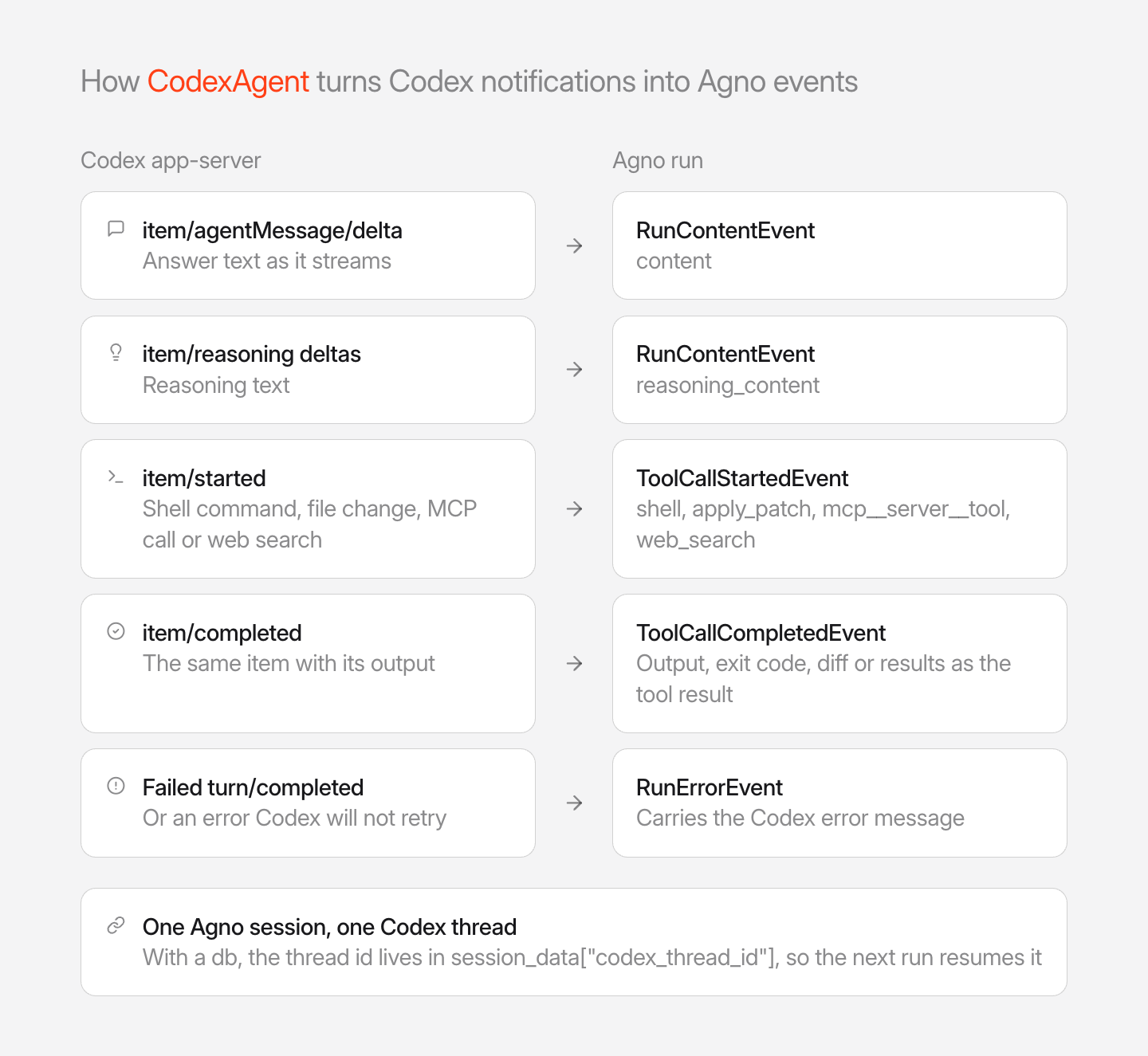
Every Agno session_id gets one Codex thread. With a db, CodexAgent saves the thread id on the Agno session, so the second message in repo-tour resumes the same thread even after a restart. Without a db, the link lives in memory for as long as the agent object does. When a thread can't be resumed, for example with ephemeral=True or after Codex deleted its session files, CodexAgent starts a fresh thread and puts the stored chat history at the top of the prompt.
The constructor maps straight onto Codex settings. sandbox takes read-only, workspace-write or full-access, and approval_mode takes auto_review or deny_all. Use deny_all on a server, since nobody is there to answer a permission request. output_schema holds Codex's final answer to a JSON Schema and returns it as a JSON string, and config passes Codex config overrides to every thread, such as an mcp_servers table. CodexAgent checks these values when a run opens its thread, and a bad one fails that run.
# real output: CodexAgent(sandbox="yolo").run("hi")
status: RunStatus.error
content: Unknown sandbox 'yolo'. Expected one of: read-only, workspace-write, full-access
See the cookbook, and learn more about running Codex in the documentation.
Frequently asked questions
Install openai-codex, sign in with codex login, then create CodexAgent from agno.agents.codex. Call .print_response() or .run() on it like a native Agno agent, or pass it to AgentOS(agents=[...]) to serve it.
Yes. CodexAgent ties every Agno session_id to one Codex thread and resumes that thread on the next run. With a db, the thread id is saved on the Agno session so the link survives restarts; without one it lasts as long as the agent object.
sandbox accepts read-only, workspace-write or full-access, and approval_mode accepts auto_review or deny_all. A server running unattended gets no approval prompt, so deny_all is the safe pick there.
Shell commands arrive as a shell tool call, file edits as apply_patch, web searches as web_search and MCP calls as mcp__<server>__<tool>, each with a started and a completed event that carries the result.
Shipped around the same time
October 8, 2026
Changelog
v3.1.2HyDE query transform for Knowledge search


Sannya Singal, Kaustubh Shukla
2 min read
October 8, 2026
Changelog
v3.1.2One browser origin policy for every AgentOS surface

Yash Pratap Solanky, Sannya Singal, and 1 other
2 min read
October 8, 2026
Changelog
v3.1.2Configure follow-up suggestions with FollowupConfig

Ashpreet Bedi, Kaustubh Shukla, and 3 others
1 min read