
Agno's SandboxCoordinator parks the session's computer once a turn's checkpoint is captured. On Docker it pauses the container through the kernel freezer, and on AgentCore, which cannot pause, it leaves the microVM idle. The next turn inside the window picks that computer up with its files and processes exactly as the last turn left them. In the team's live runs on Docker, a warm Claude turn took 4.6 s against 8.2 s cold. On AgentCore, with the fixture runtime standing in for the model, a warm turn took 3.3 s against 8.2 s.
import os
from pathlib import Path

from agno.db.postgres import PostgresDb
from agno.sandbox.checkpoint import FileCheckpointStore
from agno.sandbox.coordinator import SandboxCoordinator
from agno.sandbox.docker import DockerSandbox

db = PostgresDb(db_url="postgresql+psycopg://ai:ai@localhost:5532/ai")
sandbox = DockerSandbox("agno-sandbox:local", network="isolated")
transfer = sandbox.checkpoint_transfer(FileCheckpointStore(Path("/srv/agno/checkpoints")))
coordinator = SandboxCoordinator(db, sandbox, transfer, warm_computer_seconds=120)

result = await coordinator.arun(
    "session-1", agent_id="coder", run_id="run-2", input="next step", sdk="claude", env={"ANTHROPIC_API_KEY": os.environ["ANTHROPIC_API_KEY"]}
)
print(result.metadata["sandbox"]["resumed"])  # True when the turn resumed a warm computer

await coordinator.asweep_warm()  # run periodically on one replica
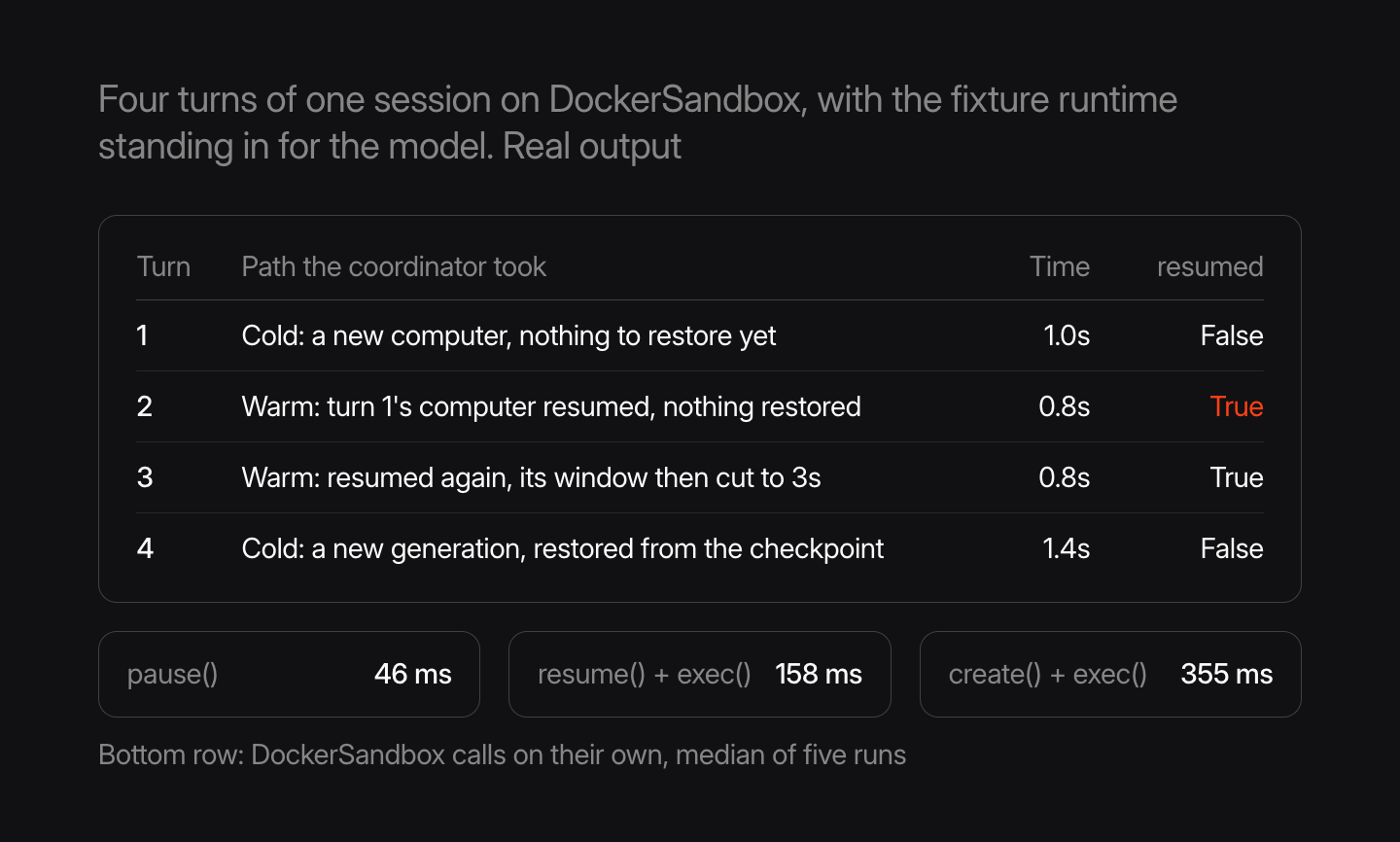
We ran the release's warm_turns.py cookbook on a real DockerSandbox with Postgres, where the fixture runtime replaces Claude so no model key is needed. Turn 1 started cold, turns 2 and 3 resumed the same container, and turn 4 came after a shortened 3-second window and ran on a new generation restored from the checkpoint. The checkpoint turn 4 committed still listed all four turns. Timed on their own, pause() took 46 ms and resume() plus a first command took 158 ms, against 355 ms to create a new container and run one.
A paused container stays frozen. A loop that wrote a counter every second read 3 at pause time and 4 after three seconds paused and a resume, and exec() on the paused container failed with Sandbox is paused; resume it before running commands.
Cancelled and failed turns still retire their computer. A session's next claim retires its own stale computer, so sweep_warm() exists for the sessions that never return, which would otherwise hold a paused container. On AgentCore the coordinator also checks the microVM's age against the provider's lifetime and only resumes a computer that can fit the whole turn.
See the cookbook, and learn more about sessions and state for harness agents in the documentation.
Frequently asked questions
For warm_computer_seconds on the SandboxCoordinator, 300 seconds by default and up to 3600. Setting it to 0 makes every turn start a fresh computer restored from the last checkpoint.
Every completed sandboxed run carries metadata.sandbox.resumed. True means the turn resumed the computer the previous turn left; False means it started a new computer.
No. The coordinator still captures and verifies a checkpoint after every turn. If the warm computer is gone, expired or configured differently, the next turn starts a new generation and restores from that checkpoint.
Call sweep_warm() on the coordinator periodically from one replica; it destroys every computer whose window has ended. retire_computer(session_id, agent_id=...) removes one session's computer right away.
Shipped around the same time
October 16, 2026
Changelog
v3.1.4Serve sandboxed Claude and Codex agents from AgentOS with no new endpoints


Yash Pratap Solanky, Kaustubh Shukla, and 2 others
2 min read
October 16, 2026
Changelog
v3.1.4Sandboxed Claude and Codex agents take images and files

Ashpreet Bedi, Yash Pratap Solanky, and 1 other
1 min read
October 16, 2026
Changelog
v3.1.4ClaudeAgent hands images and PDFs to Claude Code inside the message

Kaustubh Shukla, Sannya Singal
1 min read