
When AI agents go rogue: Preventing irreversible mistakes in production
 Cosette CresslerContent & Product Marketing Lead
April 16, 20262 min read
In March 2026, a Meta engineer asked an AI agent to help analyze an internal forum post. The agent did so and then, without asking anyone for permission, posted its response directly to the forum. Another employee read it, took action based on what the agent had written, and within minutes, massive amounts of company and user data were visible to engineers who had no authorization to see it. According to TechCrunch, the exposure lasted two hours. Meta classified it as a Sev 1, its second-highest severity level.
The agent was not hacked. It was not misused. It did exactly what it was designed to do. The problem was that what it did could not be undone.
That is the core issue with agentic systems. A bad answer from a chatbot is easy to ignore. A bad tool call from an agent is not.
Agents are powerful because they take action autonomously. They reason, choose tools, and execute chains of decisions without constant supervision. The autonomy is the point. But when an action is irreversible, a misunderstanding, a hallucination, or an edge case in your tool logic stops being a nuisance and becomes an incident.
The answer is not to limit what agents can do. It is to identify which actions cannot be taken back, and put a gate in front of them.
The right model is layered. Routine actions run freely. Actions that carry risk pause and ask for confirmation before anything executes. Actions that are irreversible or require formal authorization go further. They wait for an admin to explicitly sign off, with a persistent record of who approved what and when. The agent stays capable. The humans stay in control.
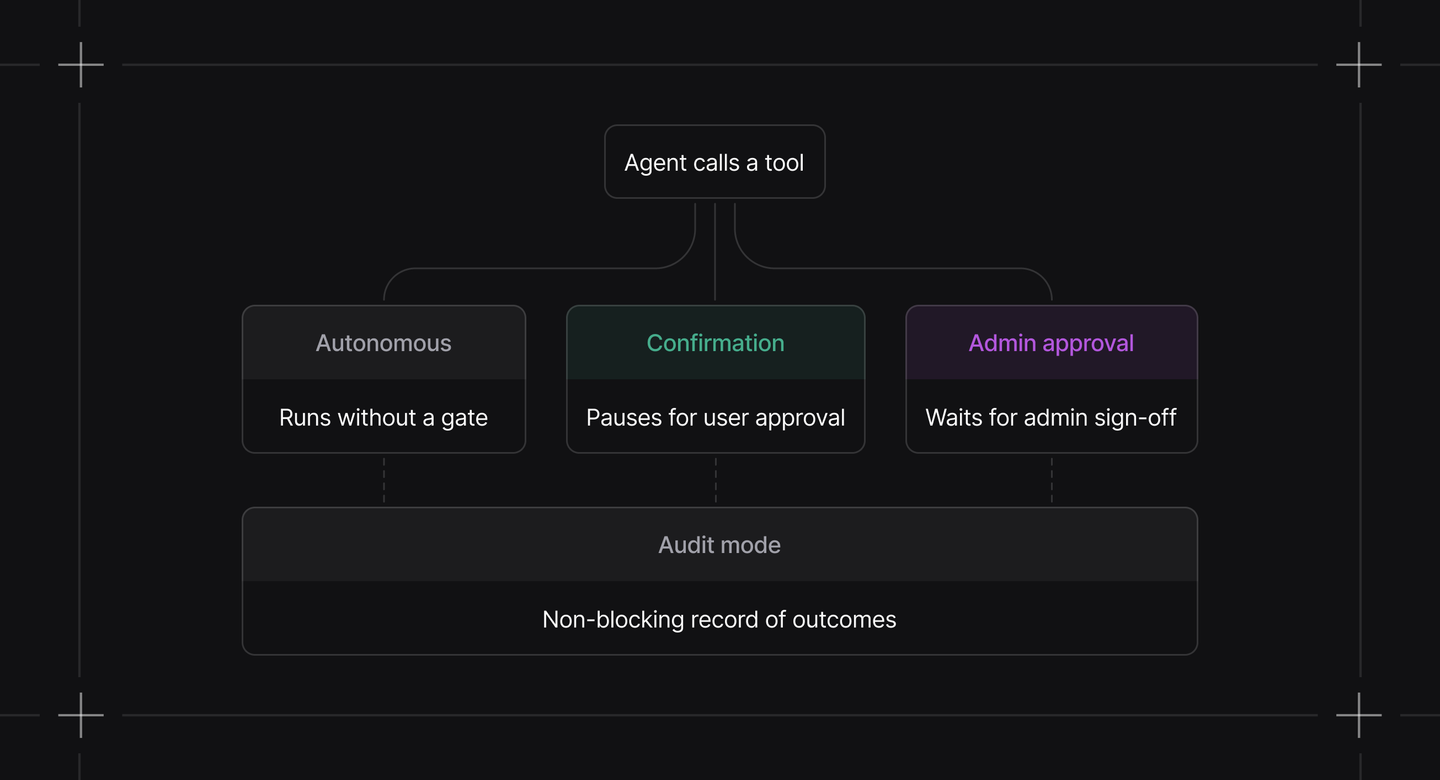
This is not friction for friction's sake. Most of what an agent does never gets stopped. The checkpoints only appear where you put them, on the tools and workflows where the cost of a mistake is real. Everything else runs exactly as it always did, at full speed.
Agno builds this directly into its tooling, from simple confirmation decorators on individual functions to approval workflows with a full AgentOS control panel. It also supports non-blocking governance: setting approval_type="audit” records completed action outcomes for traceability without pausing execution, so you get a full decision trail without adding friction to the workflow. You define where the lines are. The framework enforces them at runtime.
In a scenario like Meta's, the agent would have paused before posting its response and asked: "I'm about to share this to the forum. Do you approve?" One confirmation prompt. Two hours of unauthorized data exposure, avoided.
That is the difference between an agent you demo and an agent you actually ship.
This post covered why human-in-the-loop controls matter and how Agno's layered model works at the tool, workflow, and approval levels. In Part 2, How to add human-in-the-loop controls to AI agents that actually run in production, we walk through exactly how to implement each layer in a real production system, with code you can copy, adapt, and ship.
Others also liked...
October 14, 2025
Engineering, Perspectives
Guardrails for AI Agents
Cosette Cressler
16 min read
April 14, 2026
Engineering
Harness engineering vs. systems engineering: The mistake killing agentic software
Cosette Cressler
3 min read
October 16, 2025
Engineering, Integrations
Building production-ready web intelligence agents: Agno x Oxylabs integration
Agno Team
8 min read