
Why almost no company is AI-native yet
 Cosette CresslerContent & Product Marketing Lead
November 17, 20267 min read
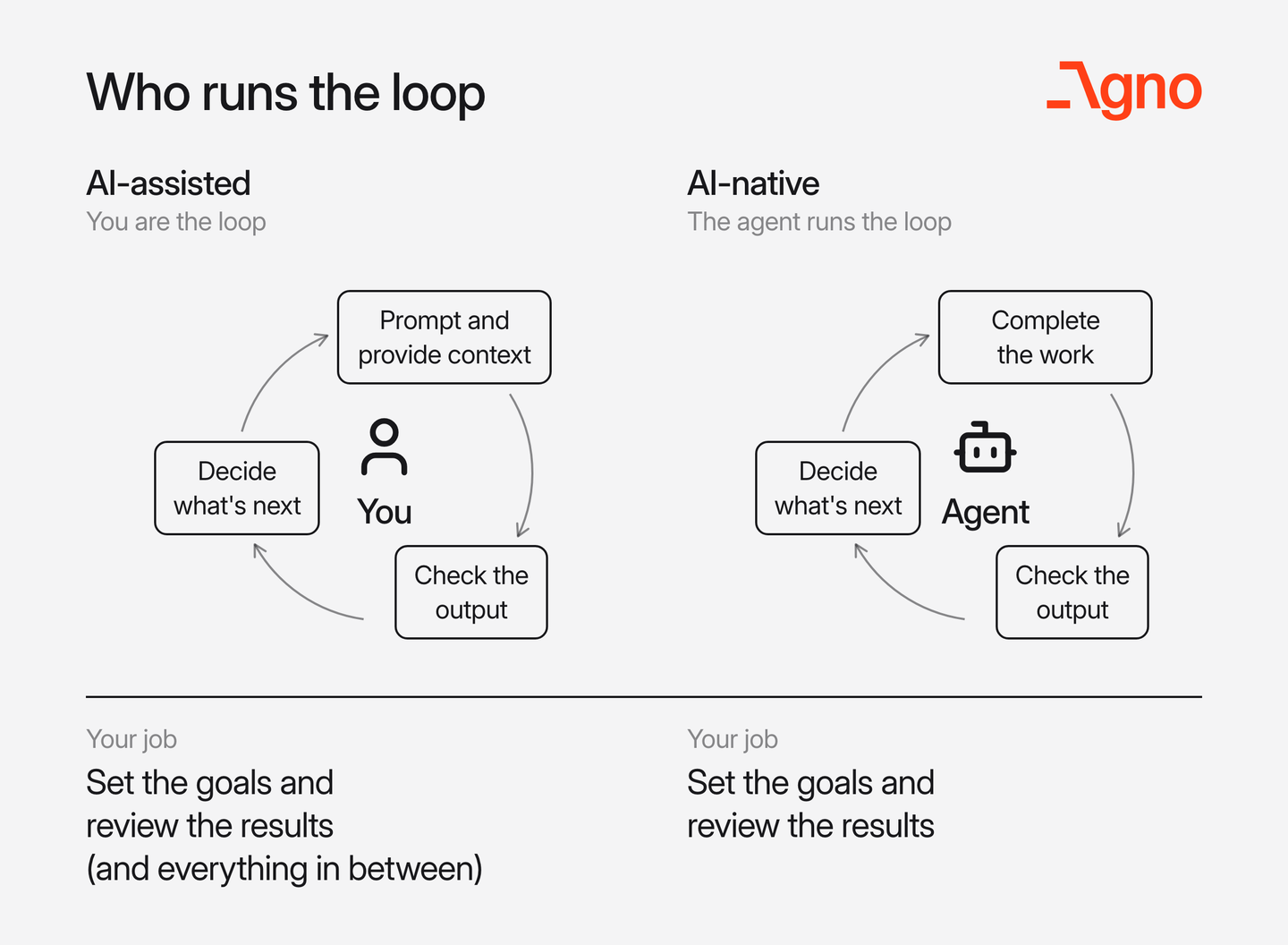
Picture a typical "agentic" workflow. You paste a bug report into a chat window and the model suggests a fix. You copy it into your editor and run the tests. When they fail, you paste the error back and ask again.
The model writes the code, but you're doing everything else. You decide whether the fix worked and what happens next. In that setup, you're the loop that keeps the agent running.
That loop describes most companies that call themselves AI-native today. They've bought the tools and handed out the licenses. But people still sit in the middle of every workflow, checking output and deciding the next step. So the gap between buying AI and running on it is wider than most leadership teams think, or than your feed would have you believe.
How many companies are AI-native today?
Very few companies are AI-native today, far fewer than the marketing suggests. Plenty of companies have rolled out AI tools, and many describe themselves as AI-native. Look closer, though, and most of their agents handle one task at a time. They summarize a ticket or draft a reply, but a person still has to decide what happens next, move the work forward, and coordinate the steps in between. AI is helping people do individual tasks faster, but people are still running the workflows. Hardly any companies let agents take responsibility for a workflow from start to finish. KPMG's first Global AI Pulse survey, conducted across 20 countries, found that only 11 percent of organizations were scaling AI agents across functions and beginning to coordinate them across workflows.
The gap shows up in the budget, too. Companies are spending heavily on AI licenses and infrastructure. And the spending is still climbing. According to KPMG's third quarterly survey, organizations planned to put an average of $210 million into AI over the coming year, up from $186 million two quarters earlier. Despite that spend, the work itself is running the same way it did before. What did change is the scrutiny around it: 61 percent now review AI costs before approving the work, while only 12 percent consistently weigh what AI delivers against what it costs. Until the work changes, that spending is hard to justify.
What does AI-native actually mean?
An AI-native company is one where AI agents own outcomes in an area of the business, while people set direction and review the results.
Most companies lose momentum somewhere between launching a few AI pilots and making AI part of how the business actually runs. So how far along is yours? Use these four levels of AI maturity to find out:
- AI-curious: Teams run scattered pilots. Nothing is in production, and nobody owns the results.
- AI-assisted: People use AI tools every day, but a person starts every task and checks every output.
- AI-augmented: Agents complete whole tasks, like triaging a ticket or drafting a report. People still decide what work gets done and hand it out.
- AI-native: Agents own an area of the business. They spot what needs doing and see it through. People set the goals and sign off on the results.
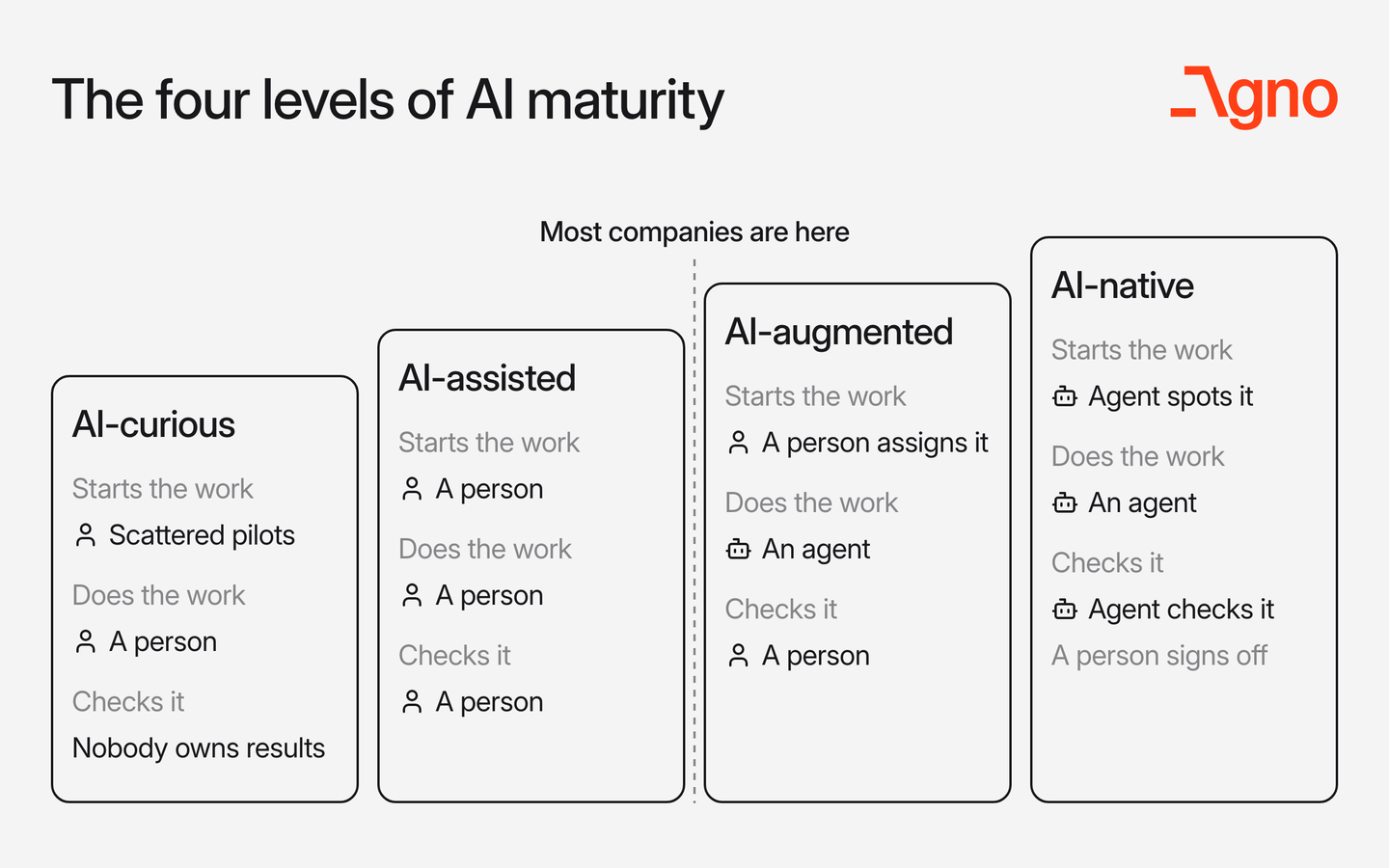
The jump from level 3 to level 4 is the one that matters. At Agno, we think of it as agents moving from task owners to product owners. A task owner hears "update this documentation page." A product owner hears "keep our documentation up to date with product changes" and works out the tasks on its own.
Why do most companies stall at AI-assisted?
Most companies stall because of how they're organized, and the same gaps come up again and again. It's tempting to blame the models. If agents can't run a workflow yet, maybe the models just aren't smart enough. In practice, the models are rarely what holds a company back.
Agents don't have your company's context
Today's models are smart enough for most enterprise work. What they lack is context. They weren't in your meetings, and they don't know the processes that live in your senior leaders' heads. For most companies, improving their context would do far more than upgrading their models.
Part of the problem is that much of that context was never written down. Ask most people to draw a flowchart of their own job, and they'll struggle. An agent can't follow a process nobody can describe.
Nobody changed who owns the work
The biggest gains won't come from employees prompting agents to finish tasks for them. They'll come when the company re-engineers its workflows around agents. Most companies have done the first and skipped the second, so agents end up as faster tools inside the same old process.
Closing the loop takes nerve
The last step is letting agents act on real systems and learn from what happens. That means letting them read production errors and ship their own fixes, even if they occasionally break something. It takes risk tolerance, and large companies aren't known for it. Instead of giving agents autonomy, they put a person at every step. Once again, a human is the loop, and the loop becomes a bottleneck instead of an automated process.
What does an AI-native company look like?
Picture a small team working alongside a much larger team of agents. Each agent owns an area of the business, like a product's codebase or its billing. Agents keep a memory of their past work and hold real permissions in the systems they own. When something breaks in production, the agent that owns it sees the error and ships a fix, often before a customer reports it.
The people on the team spend their time differently. They set direction and decide what's worth building. They also review the decisions agents escalate. As those decisions pile up, the team can write down the principles behind them, so agents can settle more questions on their own.
Agents that own an area of the business need somewhere to run that gives them memory, permissions, and a record of what they did. That is the job of AgentOS, the runtime we build at Agno.
The most prepared companies start collecting context long before they need it. Recording calls and decisions as text today gives tomorrow's agents something to work from.
How to start: Capture one workflow in 20 minutes
You don't need a company-wide program or a new platform to start climbing. You need one workflow and about 20 minutes.
1. Pick something you do regularly. Choose a task you've done over and over that still takes real judgment. A few ideas:
- Engineers: reviewing a pull request or triaging a new bug report
- Salespeople: prepping for a discovery call or writing a follow-up after a demo
- Marketers: turning a product update into a blog post or putting together the monthly performance report
- CEOs: writing the weekly update to the team or preparing for a board meeting
2. Talk through it the next time you do it. Open a voice memo or a voice AI tool and narrate as you work. If you'd rather type, keep a doc open and jot notes as you go. Explain what you're doing, step by step. And explain why.
3. Spell out the judgment behind it. Most AI agents run on the same handful of models and draw on much of the same public information. Without your expertise, they'll give the same answers everyone else gets, and that's where slop comes from.
Context, in this sense, is everything an agent needs to know about how your company works and thinks. Give the agent your knowledge, judgment, experience, lessons learned, writing quirks, and absolute no-gos. Start with these questions:
- What do you always double-check?
- What would a new hire get wrong?
- How do you know when something is good enough to ship?
- When do you break your own rules?
Together, these move an agent past a technically correct answer to one that reflects how your company thinks.
4. Add examples of finished work. Your best past work is context, too. Pull a few examples you're proud of, like a PR review that caught a real bug or a follow-up email that closed a deal. Agents learn a lot from seeing what good looks like, and even more when you add a line on why each example works.
5. Save it all in one place. Clean up the transcript, or don't. Put it next to your examples, and you've got the context an agent needs to do the work your way.
6. Test it and keep refining. Give the agent a try, then look closely at what it produces. Chances are, the output will reveal something you forgot to tell it: a preference you never mentioned or a piece of judgment you take for granted.
Don't give up on AI because the first result isn't great. Give it more context. Explain what it got wrong and why, then try again. Every round gets the output closer to what you'd have done yourself.
Download the 20-minute workflow worksheet (PDF)
How to move from AI-assisted to AI-native
If you're stuck between AI-assisted and AI-augmented, a better model won't move you on its own. The next step is organizational: agents need your company's context, and they need ownership of real work.
Start with the workflow you picked above. Who decides whether its output is right, and who decides what happens next? If the answer to both is a person, you've found your loop.
Frequently asked questions
In an AI-assisted company, people use AI tools but start every task and check every output. In an AI-native company, agents own an area of the business and see work through, while people set goals and review results.
Usually not. Today’s models are capable enough for most enterprise work. What holds most companies back is missing context and workflows that still route every step through a person.
Context is everything an agent needs to know about how your company works: what you know about your work and the judgment you bring to it. Without it, agents give the same generic answers as everyone else’s.
Start with one workflow you do regularly. Talk through it as you work and explain the judgment behind each step. Then save that alongside examples of finished work, so an agent has the context it needs to do the job your way.
Others also liked...
November 3, 2026
Perspectives
Building a Super Agent

Ashpreet Bedi
5 min read
January 22, 2026
Engineering, Perspectives
Why Agno treats performance as a first-class citizen
Cosette Cressler
3 min read
July 21, 2026
Customers, Perspectives
How Thinqpoint built real AI systems without the fluff
Cosette Cressler
10 min read