
Agno's DockerSandbox names every container after a hash of the namespace, agent, session and generation, so two replicas racing to create the same computer, or a create whose response got lost, both land on one container. Commands never retry on their own: a timeout, a cancel or an uncertain transport result stops the container, and recovery goes through the checkpoint.
from agno.agents.claude import ClaudeAgent
from agno.db.postgres import PostgresDb
from agno.sandbox.docker import DockerSandbox

agent = ClaudeAgent(
    id="coder",
    db=PostgresDb(db_url="postgresql+psycopg://ai:ai@localhost:5532/ai"),
    sandbox=DockerSandbox(
        "agno-sandbox:local",
        cpus=2.0,
        memory_mb=2048,
        pids_limit=256,
        workspace_mb=512,
        network="isolated",
    ),
)
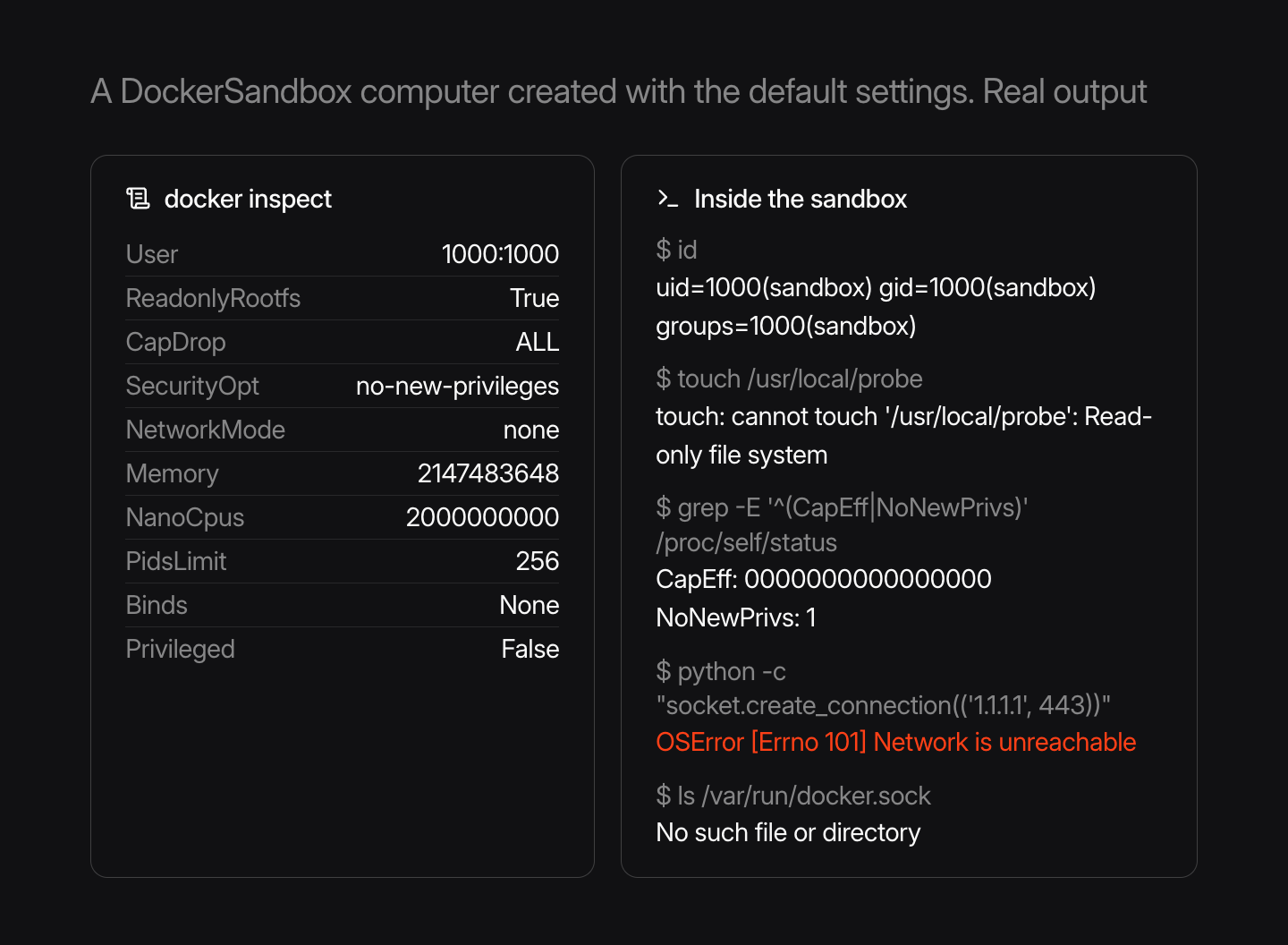
We created a real DockerSandbox computer with the default settings from the runtime image this release builds, then read back what Docker recorded and what a process inside could do. The agent's files live on bounded tmpfs volumes (512 MB at /workspace, 256 MB at /runtime), and nothing from the host is mounted, the Docker socket included.
The container sees HOME, the env= you pass, and the agent's model credential (ANTHROPIC_API_KEY or CLAUDE_CODE_OAUTH_TOKEN for Claude, OPENAI_API_KEY for Codex), which Agno forwards from the host when env= leaves it out. The values travel through a private env file, so they never appear in the host's process list.
Networking starts at none. With network="isolated", Agno creates one bridge per host called agno-sandbox, with inter-container traffic switched off, on 172.30.0.0/22 unless subnet= picks another range. Sandboxes on it reach the internet and the host's published ports, while traffic between them stays blocked. docker network inspect on that bridge showed com.docker.network.bridge.enable_icc: false, and remove_network() deleted the bridge once nothing was attached. DockerSandbox refuses network="host" and container: networking at construction.
pause() freezes a container through the kernel's cgroup freezer, with memory, processes and files kept as they were, and resume() thaws it. DockerCheckpointTransfer copies a frozen container's files in and out through the Docker daemon, with no host bind mounts. To build the runtime image, run python cookbook/frameworks/sandbox/build_image.py. It sends Docker only the public package sources, tags the image agno-sandbox:local and confirms the tag is in the image store.
See the cookbook, and learn more about running Claude and Codex as harness agents in the documentation.
Frequently asked questions
Not by default. DockerSandbox starts containers with network none, so a connection attempt fails with Network is unreachable. Pass network="isolated" to join an Agno-managed bridge where sandboxes reach the internet and the host's published ports, while traffic between sandboxes stays blocked.
By default each container gets 2 CPUs, 2048 MB of memory with no extra swap, 256 processes, a 512 MB /workspace, a 256 MB /runtime and a 128 MB /tmp. Change them with cpus=, memory_mb=, pids_limit= and workspace_mb=.
HOME, whatever you pass in env=, and for a sandboxed agent its model credential: ANTHROPIC_API_KEY or CLAUDE_CODE_OAUTH_TOKEN for Claude, OPENAI_API_KEY for Codex. Agno writes them to a private env file, so they never show in the host's process list.
Run cookbook/frameworks/sandbox/build_image.py from the Agno repository. It copies only the public package sources into a temporary build context, tags the result agno-sandbox:local and checks the image actually landed in Docker's image store.
Shipped around the same time
October 16, 2026
Changelog
v3.1.4Run sandboxed Claude and Codex agents on Amazon Bedrock AgentCore


Samuel Jupe, Kaustubh Shukla, and 1 other
3 min read
October 16, 2026
Changelog
v3.1.4Sandboxed turns resume a warm computer and restore nothing
Kaustubh Shukla
2 min read
October 16, 2026
Changelog
v3.1.4Serve sandboxed Claude and Codex agents from AgentOS with no new endpoints

Yash Pratap Solanky, Kaustubh Shukla, and 2 others
2 min read